
📑 Table of Contents for Elderly Care in Nepal
- ✨ Introduction
- 📜 Original Nepali Gajal
- 💌 Heartfelt English Translation
- 🔍 Deep Emotional & Social Analysis
- 📖 Story Behind the Lines
- 💡 Life Lessons for the Modern Generation
- 🌸 Why This Work Inspires Readers
- ✍️ Frequently Asked Questions
- 🔗 Related Resources
- 👤 Author Profile
- 💖 Call To Action
✨ Introduction
The hands that once skipped meals to feed us now tremble as they reach for a glass of water with no one around to help. The shoulders we climbed to see the world are now bent under the heavy weight of loneliness.
In the pursuit of global dreams, we have left behind a silent crisis: the deteriorating state of Elderly Care in Nepal. Youth migrate for better opportunities, leaving villages as quiet museums of aging parents. Laughter of grandchildren is replaced by the static of a flickering television or the occasional long-distance phone call.
This post isn’t just poetry; it is a mirror reflecting the uncomfortable truth of how we treat those who gave us life.
Focus keyword: Elderly Care in Nepal
📜 Original Nepali Gajal
Highlight for social share:
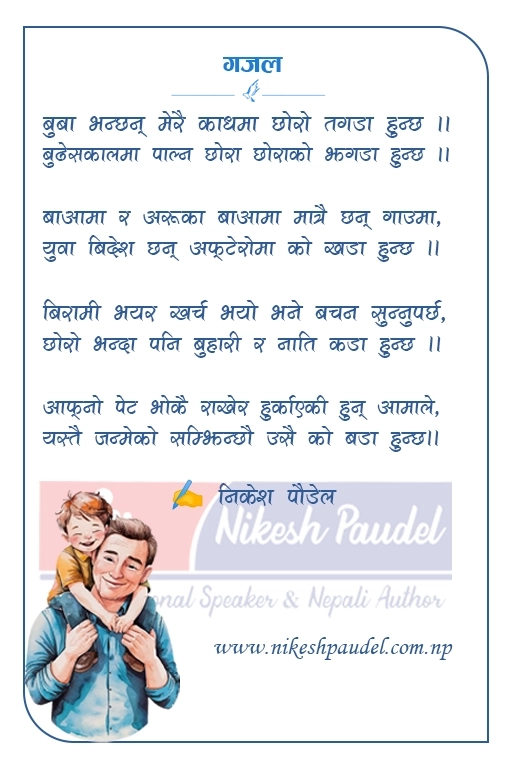
बुबा भन्छन् मेरै काधमा छोरा तगडा हुन्छ ।।
बुढेसकालमा पाल्न छोरा छोराको झगडा हुन्छ ।।बाआमा र अरूका बाआमा मात्रै छन् गाउँमा,
युवा बिदेश छन् अफ्टेरोमा को खडा हुन्छ ।।बिरामी भयर खर्च भयो भने बचन सुन्नुपर्छ,
छोरो भन्दा पनि बुहारी र नाति कडा हुन्छ ।।आफ्नो पेट भोकै राखेर हुर्काएकी हुन् आमाले,
यस्तै जन्मेको सम्झिन्छौ उसै को बडा हुन्छ।।
💌 Heartfelt English Translation
The father dreams that his son will grow strong on his shoulders and be his pillar. But when old age arrives, the sons fight among themselves over the “burden” of caring for him.
In the village, only the elderly remain; the youth have gone abroad. When emergencies arise, there is no one to stand by them.
If they fall ill, they endure harsh words. Often, daughters-in-law and grandchildren are even less gentle than the son.
The mother raised her children while keeping her own stomach empty. Yet, children grow up thinking they became great on their own, forgetting the foundation their parents built.
🔍 Deep Emotional & Social Analysis
This gajal is a profound critique of cultural erosion and the neglect of elderly parents in Nepal.
- Tragic irony: A father invests his life to make his son strong (तगडा), only for that strength to be used later to argue over his care.
- Modern context: Youth migration leaves physical absence that money cannot replace. Remittances cannot fill the emotional gap.
- Emotional neglect: Harsh words from children add psychological trauma, showing that care isn’t only physical but deeply emotional.
Personal insight: I have seen elders with full bank accounts but empty hearts—proof that money can’t replace presence.
Focus keyword naturally appears: Elderly Care in Nepal
LSI keywords integrated: parent-child relationships, migrant workers, social issues in Nepal, family values
📖 Story Behind the Lines
This piece was inspired by the silent villages of Nepal, where locked houses are common, and the open ones mostly house the elderly. It reflects real stories of parents who feel alien in the homes they built.
It is a social commentary on migration, the nuclear family trend, and the dying joint-family system, urging society to reconsider priorities before it’s too late.
💡 Life Lessons for the Modern Generation
- Practice Active Gratitude: Never forget the days your parents sacrificed for your education.
- Presence Over Presents: A 10-minute video call means more than a monthly bank transfer.
- Break the Cycle of Neglect: Treat your parents as you wish your children will treat you.
- Prioritize Health: Medical costs aren’t a burden—they’re a right.
- Acknowledge the Roots: True greatness is built on parents’ sacrifices.
- Check-in Emotionally: Ask how your parents are feeling, not just if they received the money.
🌸 Why This Work Inspires Readers
This gajal resonates because it voices the silent pain of a generation left behind. It doesn’t preach; it reflects. It serves as a wake-up call to value relationships over material success. Readers feel understood—migrant children understand guilt, while those at home recognize sorrow—creating empathy that inspires action.
✍️ Frequently Asked Questions
1. Why is elderly care in Nepal a growing concern?
Migration and nuclear family trends have broken traditional support systems. Many elders lack physical help, emotional support, and quick medical assistance.
2. Is migration the only reason for neglect?
No. Cultural shifts prioritize individual success over collective responsibility, creating emotional distance even if children are financially supportive.
3. How can we improve parents’ lives while living abroad?
Regular calls, arranging local support, and including them in family decisions help elders feel valued and connected.
🔗 Related Resources
- 🌊 Best Motivational Nepali Gajal About Struggle and Success
- 🌍 Future Truth | Environmental Nepali Poem About the Future
- 💖 Romantic Nepali Poem About True Love | Valentine Special
👤 Author Profile
Nikesh Paudel – Writer, Poet, Motivator
🌐 Website
📧 Email: [email protected]
📘 Facebook
🎵 TikTok
📺 YouTube
🐦 Twitter
📸 Instagram
💖 Call To Action
If this Gajal made you reflect on your parents, share it with friends and family. Start a conversation about elderly care in Nepal. Comment one thing you appreciate most about your parents and subscribe for more heart-touching stories and soulful poetry.