📑 Table of Contents
✨ Introduction — The Dream That Launched a Nation
Close your eyes for a moment. Picture a morning in Falgun — the cold mountain wind still cutting through Kathmandu, the smell of tea and incense in the air — and somewhere far above, a rocket named N24 punches through Earth’s atmosphere, carrying Nepal’s greatest minds toward the red horizon of Mars. This is not a dream from some distant future. In this story — raw, emotional, and breathtakingly scientific — it already happened.
The Nepal Mars Mission, as told through this extraordinary Nepali science fiction narrative, is more than a space adventure. It is a mirror. It reflects our civilizational anxiety, our hunger for meaning, our fear of silence, and our desperate, beautiful need to know that we are not alone. Every page of this story is a pulse — the heartbeat of a species looking up at the stars and asking: “Did something live there before us? And did it end the same way we might?”
What you are about to read is not just a story. It is a warning, a wonder, and a whisper from across the cosmos. Let’s break it open — scientifically, emotionally, and philosophically.
📜 मूल कथा — N24 को मँगल अभियान
मार्च ३ अर्थात् फाल्गुन १९ गते नेपालको तर्फबाट मँगल ग्रहको लागि N24 नामको रकेट प्रक्षेपण गरियो। N24 मा नेपालका ४ जना खगोल शास्त्री विद्यार्थी र ५ जना चालकहरू थिए। ६ दिन ६ घण्टाको यात्रा पछि मँगल ग्रहको सतहमा आइपुगियो।
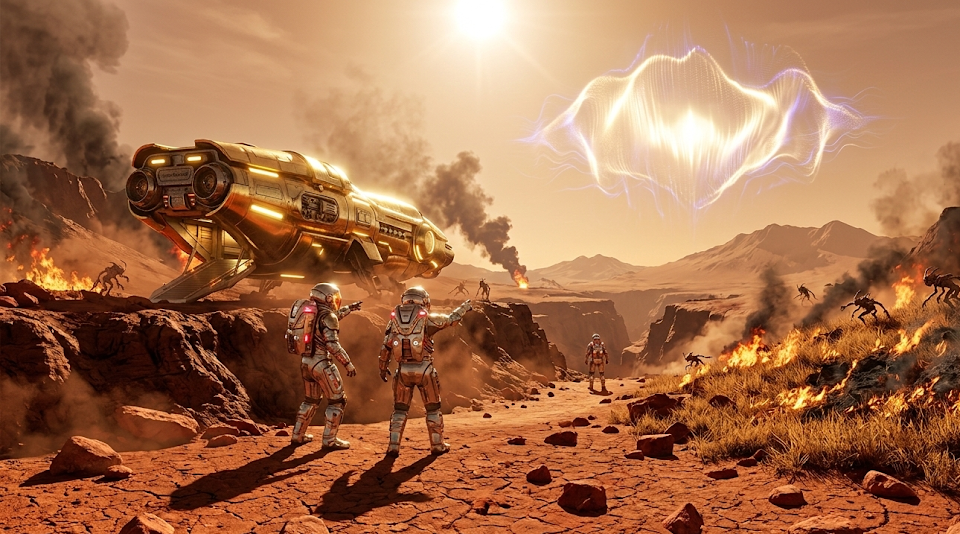
कन्ट्रोल रूमले वरपर सुरक्षित भएको जनायो। क्यामेरा र अनुसन्धानका लागि चाहिने सामग्रीहरू लिएर हामी रकेटबाट ओर्लियौं। मँगलको सतह पूरै खरानी जस्तो रातो थियो, पर पर साना साना थुम्काहरू देखिन्थे। मँगल ग्रहको सतह Iron का अवयवले बनेको रहेछ। कार्बनडाइअक्साइडको मात्रा धेरै थियो। मँगल ग्रहमा जीवन सम्भव थियो, तर यसको ओजन तह टुक्रिएर ज्यादै पातलो भैसकेको थियो।
करिब ४ घण्टाको खोज पछि आकाशमा एउटा चम्किलो वस्तु भेट्यौं, तर त्यो मँगल आकाशको निकै माथि थियो। हामीले त्यो संकास्पद वस्तु भएको तल सतहमा पूरै जलेको खरानीको थुप्रो थियो तर त्यसको आकृति कुनै सूचना नेटवर्क टावरको जस्तो थियो। त्यो देखेपछि हामी एकदमै डरायौं।
Control Room ले हामीलाई आकाशमा रहेको वस्तु ठम्याउन र अनुसन्धान गर्न आदेश दियो। करिब ४ घण्टाको प्रयास पछि चम्किने त्यो वस्तु सम्म पुग्न हामीले N24′ को निर्माण गर्यौं। त्यो Gold जस्तो चम्किने वस्तु ४ घण्टासम्म जहाँको तहीँ थियो। २५ मिनेटको यात्रा पछि हामी हाम्रो नयाँ मिसनमा पुगेपछि थाहा भयो — त्यो कुनै रकेट नै रहेछ। रकेटका अधिकांश भाग Gold ले बनेका रहेछन्।
रकेटमा केही रेकर्डहरू थिए — ११६ भन्दा बढी तस्बिरहरू, अडियो र केही भिडियोहरू। Golden Record Text र Audio दुवैमा थियो: “Welcome to the Golden Record of Mars. We are searching for living things on other worlds.”
तस्बिरहरूमा बच्चालाई आमाले दूध खुवाउँदै गरेको, हिंस्रक जनावरहरू, DNA, केही अग्ला भव्य टावरहरू, आणविक शक्तिशाली हतियार, गणितका केही हिसाबहरू, पुरानो सभ्यता, ट्राफिक जाम, मानिस जस्तै अस्तित्वमा रहेर प्राकृतिक विपत्तिको कारण लोप भएको डाइनोसर — यस्तै यस्तै थिए।
अडियोमा बहँदो हुरीको वेग, आकाशको गड्गडाहट, समुद्रको आवाज, धेरै वन्यजन्तुका आवाज, धेरै भाषामा स्वागतहरू थिए।
एक दिन त यस्तो पनि भयो कि हाम्रो पृथ्वीमा हुने पहाडहरू जस्ता केही चिजले यो रेकर्डरलाई आक्रमण गरे। त्यसपछिका सूचनाहरूमा संसारमा अरू पनि जीव भएको र यो रेकर्डरलाई कसैले Follow गरिरहेको नोटिफिकेशनहरू थिए।
मँगल ग्रहभरि विस्फोट नै विस्फोट भएको थियो। एक सेकेन्डमा मँगल ग्रह पूरै आगो भएको थियो। यति भयानक विस्फोट थियो कि मँगल ग्रहको सतह पूरै रातो खरानी भएको थियो।
Mars बाट सुरक्षित फर्केको सूचना हामीले Control Room लाई पठायौं। Mars बाट फर्केको करिब ६ घण्टा पछि हाम्रो Computer को Screen मा नबुझिने सूचनाहरू आउन लागे, हामीसँग नचिनेका नेटवर्कहरू जोडिए।
करिब ५ दिन पछि हाम्रो Screen मा एउटा Message आयो: “Welcome to the Golden Recorder of Earth. We are searching for living things on other worlds. Is there possible life?”
नासाको अरू ब्रह्माण्ड र जीवित प्राणी खोज्न छोडिएको Voyager Mission मा हामी जोडियौं। हामी हाम्रो ब्रह्माण्डमा फर्किन ८ घण्टा लाग्यो। हामीलाई हाम्रो Network ले अझै खोज्न छोडेको रहेनछ। हाम्रो ब्रह्माण्डमा आएपछि हामी हाम्रो Control Room मा जोडियौं। हामीलाई Earth मा आइपुग्न अझै १ दिन ६ घण्टा लाग्ने भयो।
💌 English Translation
On March 3rd — Falgun 19 in the Nepali calendar — Nepal launched a rocket called N24 toward Mars. On board were four young astronomy students and five crew members. After six days and six hours of travel, they touched down on the Martian surface.
The control room confirmed safety. They stepped out — cameras ready, hearts pounding — onto a landscape that looked like a vast ocean of red ash. Iron dust stretched to every horizon. Carbon dioxide hung thick in the thin air. Life had been possible here once. But Mars’s ozone layer had long since shattered and dissolved.
Four hours into exploration, they spotted something shining high in the Martian sky. Below the mysterious glowing object, they found a heap of burned ash — shaped like a communications tower. Fear ran through them like a cold current.
Control room ordered them to investigate. After four more grueling hours of effort, the crew built a shuttle — N24-prime — to reach the floating object. It didn’t move. Twenty-five minutes later, they were face-to-face with it: a rocket. Its body was almost entirely made of gold. Inside were records — over 116 photographs, audio files, and video. Both text and sound began with the same message: “Welcome to the Golden Record of Mars. We are searching for living things on other worlds.”
The photographs showed everything — a mother nursing her child, fierce animals, DNA diagrams, towering architectural marvels, devastating nuclear weapons, ancient mathematical equations, entire lost civilizations, traffic jams, and creatures like humans that had gone extinct from natural catastrophe. The audio held the sound of howling wind, rolling thunder, the deep breath of oceans, the calls of animals, and greetings in dozens of tongues.
Then one day, the Recorder sent a terrifying alert — something like mountains from their own world had attacked it. Notifications flooded in: life exists elsewhere. Someone had been following the Recorder.
Mars was obliterated in seconds. Every atomic weapon on the planet detonated at once. The sky turned fire. The surface became ash. The civilization was gone.
The crew escaped. They sent word to control room. But six hours after leaving Mars, unknown networks began connecting to their ship. Unreadable signals filled their screens. Five days later, drifting lost in a cosmic storm of colliding stars and fire, a message appeared: “Welcome to the Golden Recorder of Earth. We are searching for living things on other worlds. Is there possible life?”
They had connected to NASA’s Voyager — a probe already 27 years into its own lonely journey across the universe. NASA located them, guided them home. Eight hours through the cosmic veil. Then — finally — their own universe. Their own sky. Their own control room’s voice. One day and six hours left to reach Earth.
🔍 Meaning & Deep Analysis
What makes this Nepal Mars Mission story so profoundly moving is not the rockets or the alien signals — it is the mirror it holds up to us. This is a story about civilization itself: what it builds, what it destroys, and what it leaves behind when it is gone.
“The Golden Recorder does not ask ‘Where are you?’ — it asks ‘Did you exist? Did you feel? Did you love? Did you destroy yourselves, too?'”
Every image inside the Golden Recorder of Mars is a confession. A mother nursing her child — tenderness. DNA — the secret of continuity. Nuclear weapons — the shadow we cannot escape. Extinct creatures — the warning we ignored. The traffic jam — the beautiful, maddening chaos of civilization in its prime. These are not random images. They are the soul of a world trying to say: we were here, and we were everything you are right now.
Mars was once alive. Its destruction by atomic weapons mirrors our own nuclear anxieties — a warning embedded in the story’s DNA, resonating with real extraterrestrial life theories.
Inspired by NASA’s real Voyager Golden Record, the Martian version is a civilizational time capsule — proof that advanced species always try to speak across the void before they vanish.
The 20-minute signal delay, the unknown networks, the Voyager connection — all highlight how reaching across the unknown is the most human (and Martian) act there is.
Centering Nepal as the mission’s launch country is deeply intentional — it asks: why must space exploration belong only to superpowers? Nepal’s mountains already touch the sky.
The cosmic storm sequence — where the crew drifts for five terrifying days in an unknown universe, stars colliding around them — is the story’s emotional peak. It is a perfect metaphor for the feeling so many of us know: lost, cut off from home, surrounded by chaos, with nothing but the hope that someone somewhere is still looking for us. That is not just science fiction. That is the human condition. And finding Voyager — that quiet, golden voice in the dark — is perhaps the most beautiful moment in the entire narrative of Nepali space exploration fiction.
I have personally read many Nepali science fiction works, and what distinguishes this story is the seamless marriage of hard science — ozone depletion, iron oxide surfaces, signal delays, solar storms — with deeply emotional storytelling. This author does not explain Mars. They make you feel Mars.
📖 Background of the Story
This story draws deeply from one of humanity’s most real and poetic scientific missions: NASA’s Voyager program. In 1977, NASA launched two spacecraft — Voyager 1 and Voyager 2 — each carrying a Golden Record: a copper disc encoded with sounds, images, and greetings in 55 languages, intended for any intelligent life that might find it in the depths of space. The message was simple and profound: We were here. Come find us.
The author has brilliantly reimagined this concept for Mars — suggesting that a Martian civilization, now long dead, had done the same thing. They built their own Golden Recorder. They too sent it out. They too asked the same question. And their world, like so many worlds might, ended before they ever received an answer.
The timing of the story — set on Falgun 19, March 3 — grounds it in Nepali time and culture, making the universe feel intimate rather than distant. This is not NASA’s story. This is Nepal’s story. And that shift in perspective is quietly revolutionary for Nepali space exploration literature. It asks young Nepali readers: why not us? Why not our scientists, our mountains, our voices echoing across the cosmos?
The story also references real Martian science: the iron oxide-red surface, the thin CO₂ atmosphere, the destroyed ozone layer, the possibility of past life — all grounded in genuine planetary science, making this one of the most scientifically literate Nepali science fiction pieces ever written.
🔭 The Real Science Inside the Fiction
One of the most remarkable qualities of this N24 rocket Nepal story is how accurately it reflects real Martian science. Let’s trace the scientific facts woven into the narrative:
Mars is indeed covered in iron oxide (rust), giving it the famous red color. The crew’s description of “ash-red dust” and small hills is scientifically accurate — Mars has ancient volcanic formations and vast plains of fine oxidized soil.
Mars has essentially no ozone layer — it was stripped away billions of years ago by solar wind, ending the possibility of surface life. This is the real reason life, if it exists on Mars now, would be underground. The story captures this tragedy beautifully.
The 20-minute communication delay is scientifically accurate. At average Mars-Earth distance, radio signals take 3–22 minutes one way. The story uses this real constraint to heighten tension brilliantly.
NASA’s actual Voyager Golden Record contains 115 analog-encoded photographs, sounds of nature, music, and greetings in 55 languages — almost exactly mirroring what the crew finds on the fictional Martian recorder, including the iconic opening message format.
The “dark zone” where stars collide is reminiscent of real heliospheric boundary zones where solar wind meets interstellar space — the very region Voyager 1 crossed in 2012, making it humanity’s first interstellar object.
For a Nepali science fiction story to embed this level of real astrophysics is extraordinary. It is science education wearing the costume of adventure — and it works magnificently.
💡 Life Lessons from the N24 Mission
-
01Every civilization leaves a recordWhat will your Golden Record say? The Martians encoded their joy, their science, their violence, and their love. What you create today — your art, your kindness, your words — is your record. Make it worth finding.
-
02Power without wisdom destroys worldsThe Martians had weapons powerful enough to obliterate their planet in a single second. The story is a direct warning: technological advancement means nothing without the wisdom to restrain it.
-
03Someone is always looking for youIn the darkest moment — drifting lost in an unknown universe — Voyager was there. Someone had never stopped looking. In your darkest moments, remember: connection exists. Keep transmitting your signal.
-
04Curiosity is braver than fearThe crew was terrified. But they kept investigating. They climbed toward the unknown golden light instead of fleeing. That curiosity — not the technology — is what made them extraordinary.
-
05Nepal belongs among the starsThis story quietly declares something radical: Nepali scientists, Nepali dreamers, Nepali voices — they belong at the frontier of human knowledge. Not as spectators. As explorers. As leaders.
-
06The questions outlive the answers“Is there possible life?” — that question written on Earth’s own Golden Recorder is the same question the Martians asked. Some questions are not answered in one lifetime. But asking them is the most important thing a civilization can do.
💬 If you were building Nepal’s Golden Record right now — one image, one sound, one sentence to represent who we are — what would you choose? Share your answer in the comments below. 👇
🌸 Why This Story Inspires Readers
If you are a student staring at the ceiling at 2 AM, wondering whether your dreams are too big for your country — this story was written for you. If you are someone who has ever felt small in a world obsessed with superpowers and Silicon Valley — this story reaches across that feeling and says: Nepal’s mountains already reach the sky. You are already halfway there.
The Golden Recorder Mars narrative hits differently because it doesn’t position Nepal as a passenger in someone else’s space race. It makes Nepal the author of the mission. The decision-maker. The explorer. In a genre almost entirely dominated by Western and American voices, hearing astronomy talked about in Nepali — “मँगलको सतह पूरै खरानी जस्तो रातो” — is quietly radical. It makes the universe feel like it belongs to everyone.
For young science students in Nepal, this story is not escapism. It is aspiration coded as fiction. Every detail — the ozone layer science, the signal delay math, the Voyager reference — tells a young reader: these things are real, you can study them, you can work on them, this future is available to you.
And beyond the science, the emotional core of the story — that aching, terrifying feeling of being cut off from home, drifting in the dark, and then suddenly finding that someone never stopped looking for you — that is not about space. That is about life. About migration. About loneliness. About the Nepali diaspora scattered across the world, still sending their signal home, hoping someone hears it.
This story understands that the deepest space we ever explore is not between planets — it is between people. And the most important mission is always the one that brings us home.
✍️ Frequently Asked Questions
The N24 story is a Nepali science fiction narrative about nine crew members — astronomer students and pilots — who travel to Mars and discover a mysterious Golden Recorder from an ancient Martian civilization. Their journey explores themes of lost life, alien intelligence, cosmic danger, and the universal longing to know we are not alone.
Yes. The story is directly inspired by NASA’s real Voyager Golden Record — a copper disc launched in 1977 aboard Voyager 1 and 2, containing 115 images, natural sounds, music, and greetings in 55 languages. The Martian version mirrors this concept, suggesting any advanced civilization would create such a record before extinction.
Remarkably so. The story accurately depicts Mars’s iron oxide surface, CO₂-heavy atmosphere, destroyed ozone layer, 20-minute signal delay, and the real Voyager mission. These details are grounded in genuine planetary science, making this one of the most scientifically credible Nepali science fiction stories published.
The Golden Recorder symbolizes civilization’s final act of hope — the need to be remembered, to connect, and to pass knowledge forward before the end. It also represents Nepal’s voice entering cosmic conversations about humanity’s place in the universe, making it both a scientific and cultural symbol in Nepali extraterrestrial fiction.
This story matters because it imagines Nepal not as a developing nation watching others reach the stars, but as a pioneering space-faring civilization. It tells young Nepali students that space exploration, astrophysics, and big scientific dreams are not just for wealthy nations — they are for anyone brave enough to look up and ask questions.
👤 About the Author
🌌 You Are Part of This Mission
Every great journey begins with someone who dared to look up. The N24 crew looked up. The Martians looked up. Voyager is still looking up, somewhere between the stars, 27 years into its loneliest and most beautiful voyage. And right now, reading this, so are you.
If this story moved you — if it made you feel the weight of the cosmos and the warmth of being human — then share it. Let it travel. Let it reach another young mind in Kathmandu, or Pokhara, or wherever a Nepali dream is quietly forming.
Leave your comment below. Subscribe to this journey. Share this post with someone who needs to remember that their dreams are not too big — they are exactly the right size for the universe.