
📑 Table of Contents
- ✨ Introduction
- 📜 Original Nepali Gajal
- 💌 English Translation
- 🔍 Meaning & Explanation
- 📖 Background of the Work
- 💡 Life Lessons
- 🌸 Why This Work Inspires Readers
- ✍️ FAQ
- 🔗 Related Posts
- 👤 Author Profile
- 💖 Call To Action
✨ Introduction
Time doesn’t knock before it changes us.
It simply moves — and we realize later that nothing feels the same.
This Emotional Nepali Gajal captures that quiet transformation — of memories, hearts, and relationships that slowly shrink without warning.
We often think change is loud.
But sometimes, it happens in silence.
📜 Best Nepali Gajal
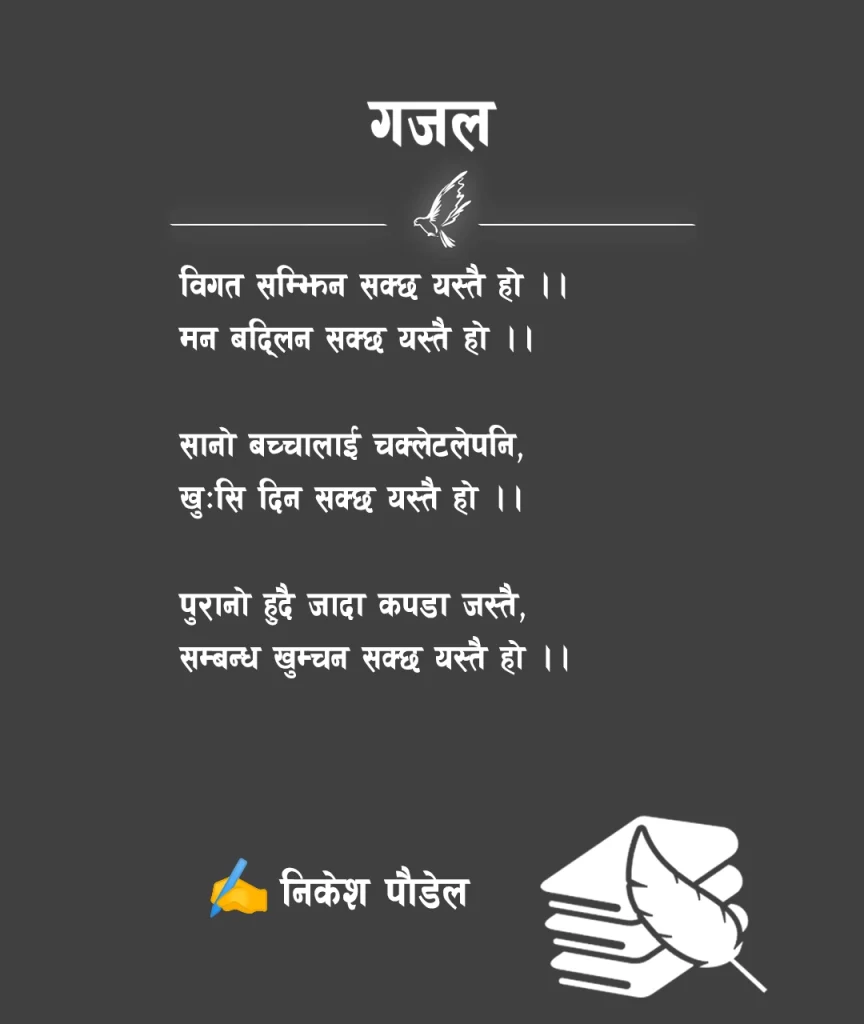
विगत सम्झिन सक्छ यस्तै हो ।।
मन बद्लिन सक्छ यस्तै हो ।।सानो बच्चालाई चक्लेटलेपनि,
खुःसि दिन सक्छ यस्तै हो ।।पुरानो हुदै जादा कपडा जस्तै,
सम्बन्ध खुम्चन सक्छ यस्तै हो ।।
💌 English Translation
The past can suddenly return — that’s how life is.
Hearts can change too — that’s how life is.A small child can find happiness even in a simple chocolate —
Sometimes, joy is that effortless.Like clothes that shrink as they grow old,
Relationships too can tighten, wrinkle, and lose their comfort.
This is life.
Gentle. Beautiful. Painful.
🔍 Meaning & Explanation
This Emotional Nepali Gajal explores one of the most unavoidable truths of life — change.
The first couplet reflects nostalgia. Memories don’t fade permanently; they resurface when least expected. At the same time, the human heart is not fixed. It evolves, adapts, sometimes hardens.
The second stanza introduces innocence. A child’s happiness from a simple chocolate contrasts sharply with adult complexity. When did joy become expensive? When did satisfaction become rare?
The final lines deliver the deepest metaphor.
Relationships shrinking like old clothes.
It’s subtle but powerful.
No dramatic betrayal.
No loud conflict.
Just slow emotional distance.
As someone who has seen friendships fade without fights and family bonds weaken due to ego or silence, I feel this Emotional Nepali Gajal speaks directly to modern reality.
This heartfelt Nepali Gajal doesn’t accuse anyone. It simply accepts change as part of life — painful yet natural.
Unlike overly dramatic sad Nepali Gajal pieces, this touching Nepali poem uses simplicity to deliver depth. And that simplicity makes it relatable.
📖 Background of the Work
In today’s fast-moving world, relationships face silent pressure — career demands, migration, social media distractions, personal growth in different directions.
This Nepali poetry about life likely draws inspiration from everyday observation:
- Childhood innocence fading
- Old friendships losing warmth
- Family bonds tested by time
It reflects a social truth — not every relationship breaks loudly. Some just slowly shrink.
And that quiet shrinking hurts the most.
💡 Life Lessons from This Emotional Nepali Gajal
- Change is natural; resisting it only adds pain.
- Happiness is often simpler than we think.
- Emotional distance grows when communication shrinks.
- Nostalgia reminds us of who we used to be.
- Relationships require effort to stay comfortable.
- Growth should not mean forgetting people who shaped us.
👉 Which relationship in your life feels different today compared to a few years ago?
🌸 Why This Work Inspires Readers
This Emotional Nepali Gajal resonates because it reflects:
- Changing friendships
- Evolving love
- Generational gaps
- Emotional maturity
Students moving to new cities.
Friends drifting apart after graduation.
Families adjusting to new realities.
Everyone experiences this.
It reminds us that while change is inevitable, awareness can prevent regret.
If you enjoy reading heartfelt Nepali Gajal pieces like this, explore this collection of Nepali Gajal for more emotional depth.
You may also love these reflective works:
- Nepali Gajal about dreams vs reality
- Nepali Gajal on dreams and sacrifice
- Best Nepali Love Poem
- Mother vs Girlfriend Priority in Modern Life
Each one reflects real emotions we often hesitate to express.
✍️ FAQ
1. Why do Emotional Nepali Gajal pieces feel so relatable?
Because they reflect everyday experiences — love, loss, change, nostalgia. The simplicity of language combined with emotional honesty makes readers see their own lives within the verses.
2. What is the main theme of this Emotional Nepali Gajal?
The main theme is change — how hearts evolve, how happiness shifts, and how relationships slowly transform over time.
3. Why is childhood happiness compared to chocolate?
It symbolizes innocence. A child finds joy in small things, unlike adults who complicate happiness with expectations and pressure.
4. How can we prevent relationships from “shrinking”?
Consistent communication, appreciation, and emotional presence are key. Relationships need attention just like anything valuable in life.
👤 Author Profile
Nikesh Paudel
Writer | Digital Creator | Motivational Voice
🌐 Website: https://www.nikeshpaudel.com.np
📧 Email: [email protected]
📘 Facebook: https://www.facebook.com/nikeshpaudel2
🎵 TikTok: https://www.tiktok.com/@nikeshpaudelofficial
▶️ YouTube: https://www.youtube.com/@nikeshpaudel
🐦 Twitter: https://www.twitter.com/nikeshpaudel
📸 Instagram: https://www.instagram.com/nikeshpaudelofficial
Motivational Quote:
“Some relationships don’t end loudly — they fade quietly. Protect them before silence replaces laughter.”
💖 Call To Action
If this Emotional Nepali Gajal reminded you of someone, don’t ignore that feeling.
Share it.
Reconnect.
Send a message you’ve been postponing.
Comment below —
Which line felt like it was written about your life?
Let’s keep poetry alive not just in words,
but in actions. 💛