
📑 Table of Contents
- Introduction
- Original Nepali Gajal
- English Translation
- Meaning & Emotional Explanation
- Background Context
- Life Lessons
- Why This Gajal Connects Deeply
- FAQ
- Related Posts
- Author Profile
- Call to Action
✨ Introduction
“He comes to the city for a job… but his heart never leaves the village.”
In crowded streets, he still searches for the warmth of home.”
This Nepali Gajal captures the silent emotional journey of thousands of sons and daughters who leave their villages for education and employment.
They come chasing opportunity — but carry memories, expectations, and fragile dreams in their eyes.
This Nepali Gajal is not just about migration. It is about hope, disillusionment, morality, and the strange nostalgia of growing up.
📜 Best Nepali Gajal
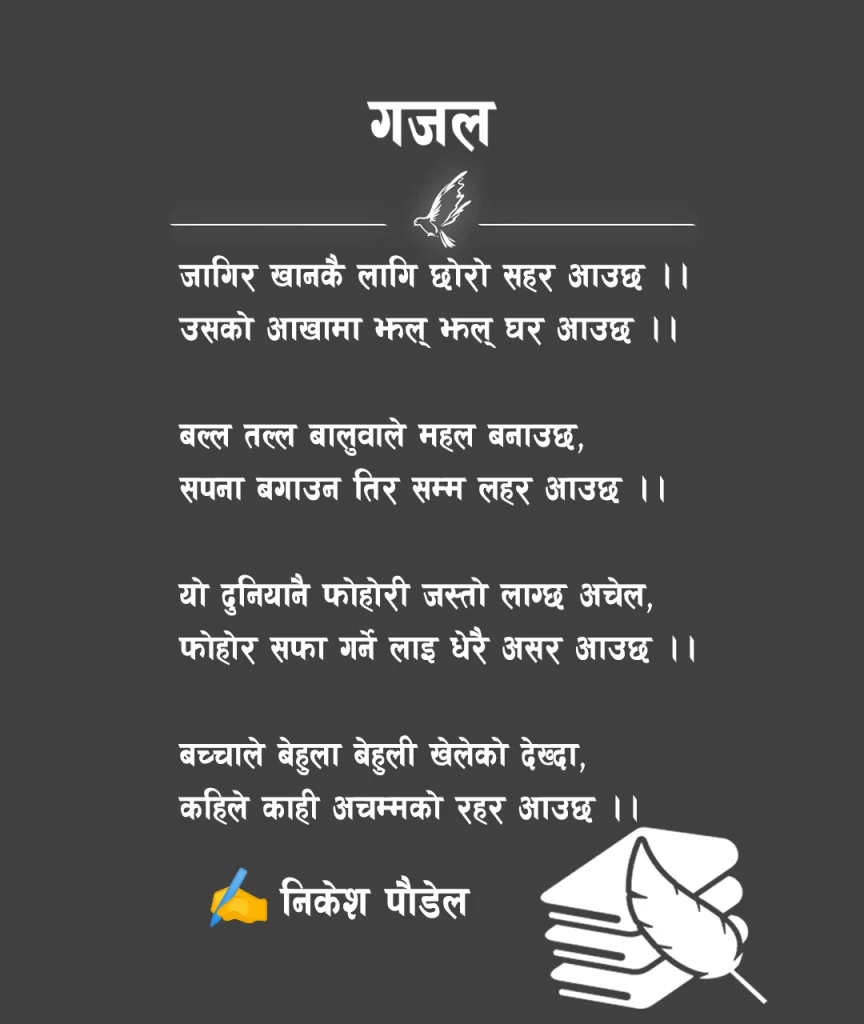
जागिर खानकै लागि छोरो सहर आउछ ||
उसको आखामा झल् झल् घर आउछ ||बल्ल तल्ल बालुवाले महल बनाउछ,
सपना बगाउन तिर सम्म लहर आउछ ||यो दुनियानै फोहोरी जस्तो लाग्छ अचेल,
फोहोर सफा गर्ने लाइ धेरै असर आउछ ||बच्चाले बेहुला बेहुली खेलेको देख्दा,
कहिले काही अचम्मको रहर आउछ ||
💌 English Translation
He comes to the city just to earn a living,
Yet in his eyes, his home keeps shimmering.With great effort, he builds palaces out of sand,
But waves rise quickly to wash away what he planned.These days, the world feels painfully unclean,
Those who try to clean it suffer in between.When he sees children playing bride and groom,
He smiles strangely — remembering his own childhood bloom.
🔍 Meaning & Emotional Explanation
This Nepali Gajal beautifully portrays the emotional contradiction of migration.
The first couplet sets the emotional foundation. A son comes to the city for a job because opportunities in the village are limited. Yet, his eyes constantly reflect home — his parents, fields, childhood memories. This theme is central in emotional Nepali poetry about youth migration.
The second stanza uses the metaphor of a sandcastle. Dreams are built with immense effort — education, struggle, sacrifice. But like sand structures near waves, many dreams collapse due to economic pressure, corruption, or lack of opportunity. This Nepali Gajal shows how fragile ambition can be.
The third stanza highlights moral conflict. The world appears “dirty” because injustice and wrongdoing seem normal. But the most painful truth? Those who try to clean the system often face consequences themselves. Standing for justice sometimes traps the honest person. This reflects a strong theme in social Nepali Gajal writing.
Personally, I believe this Nepali Gajal captures the silent frustration of a generation. We want to change the world — yet we struggle just to survive in it.
The final stanza brings nostalgic innocence. Watching children play bride and groom reminds the speaker of his own childhood wishes. Back then, life felt simple. Dreams were pure. Now, adulthood feels heavy. This emotional shift makes the Nepali Gajal deeply relatable.
The focus keyword Nepali Gajal resonates strongly here because the piece reflects:
- Migration for education and job
- Broken dreams
- Moral struggle in society
- Childhood innocence vs adult reality
This is motivational Nepali literature — not because it promises success, but because it validates emotion.
📖 Background Context
In many parts of Nepal, job opportunities in villages are limited. Young people move to cities for higher education and employment. They carry family expectations and personal dreams.
However:
- Economic instability
- Social injustice
- Competitive job markets
- Corruption
often make dreams harder to achieve.
This Nepali poem about migration reflects a real social pattern — youth displacement, urban struggle, and emotional disconnection from roots.
💡 Life Lessons From This Nepali Gajal
- Opportunity often requires leaving comfort behind.
- Dreams need resilience because reality tests them.
- Not every injustice can be fought easily — choose battles wisely.
- Never forget your roots while chasing success.
- Childhood innocence reminds us who we truly are.
- Build dreams stronger than sand — with patience and skill.
👉 Question for you:
Have you ever chased a dream that felt strong at first but slowly slipped away like sand?
🌸 Why This Gajal Connects Deeply With Readers
This Nepali Gajal touches students preparing for exams, job seekers struggling in cities, and anyone who has felt homesick.
It connects because:
- Many youths study in cities away from parents.
- Many build ambitious dreams that reality reshapes.
- Many feel frustrated by corruption and injustice.
- Many miss their carefree childhood days.
It speaks softly — but truthfully.
If you enjoy reading such emotional Nepali poetry, explore more heartfelt creations in this collection:
👉 https://nikeshpaudel.com.np/nepali-gajal/
You may also like reflective works from the Nepali poem archive:
👉 https://nikeshpaudel.com.np/nepali-poem/
For a deeper emotional journey, read this powerful romantic Nepali Gajal set in a hospital:
👉 https://nikeshpaudel.com.np/romantic-nepali-gajal-nurse-hospital/
And don’t miss this socially powerful piece about elderly care challenges:
👉 https://nikeshpaudel.com.np/challenges-of-elderly-care-in-nepal-gajal/
✍️ FAQ
1. What is the core message of this Nepali Gajal?
This Nepali Gajal highlights migration, fragile dreams, and moral struggles in modern society. It emphasizes emotional resilience and nostalgia for simpler times.
2. Why do many Nepali Gajal focus on city migration?
Because migration is a lived reality for many Nepali youths. Poetry becomes a powerful medium to express homesickness, ambition, and disappointment.
3. Is this Nepali Gajal motivational?
Yes. It motivates through emotional truth. It teaches resilience, awareness, and staying grounded while chasing dreams.
4. Who can relate most to this poem?
Students, job seekers, migrants, and anyone who has struggled between dreams and reality will deeply connect.
👤 Author Profile
Nikesh Paudel
Writer | SEO Strategist | Literary Analyst | Motivational Content Creator
🌐 Website: https://www.nikeshpaudel.com.np
📧 Email: [email protected]
📘 Facebook: https://www.facebook.com/nikeshpaudel2
🎵 TikTok: https://www.tiktok.com/@nikeshpaudelofficial
▶️ YouTube: https://www.youtube.com/@nikeshpaudel
🐦 Twitter: https://www.twitter.com/nikeshpaudel
📸 Instagram: https://www.instagram.com/nikeshpaudelofficial
Motivational Quote:
“Dreams may break like sandcastles — but courage rebuilds them stronger.”
💖 Call To Action
If this Nepali Gajal reflected your journey, don’t keep it to yourself.
Share it with a friend living away from home.
Comment your story of dreams and struggles.
Subscribe for more emotional Nepali poetry and social reflections.
Let’s build a community where dreams are shared, struggles are respected, and roots are never forgotten.
Because sometimes…
The city changes us but the village still lives inside us. 🌿