
📑 Table of Contents
- Introduction
- Best Nepali Gajal
- English Translation
- Meaning & Explanation
- Background of the Work
- Life Lessons
- Why This Work Inspires Readers
- FAQ
- Related Posts
- Author Profile
- Call To Action
✨ Introduction
Some betrayals don’t break you instantly — they slowly reshape who you become.
Some truths are painful not because you didn’t know them, but because you always did.
This Nepali Gajal speaks directly to the heart of silent suffering. It captures betrayal in relationships, political deception, and emotional hypocrisy with raw honesty. If you have ever trusted someone deeply only to see them change, this piece will feel personal.
The power of this Nepali Gajal lies in its calm confidence — it doesn’t scream, it simply says: “I know.”
📜 Best Nepali Gajal
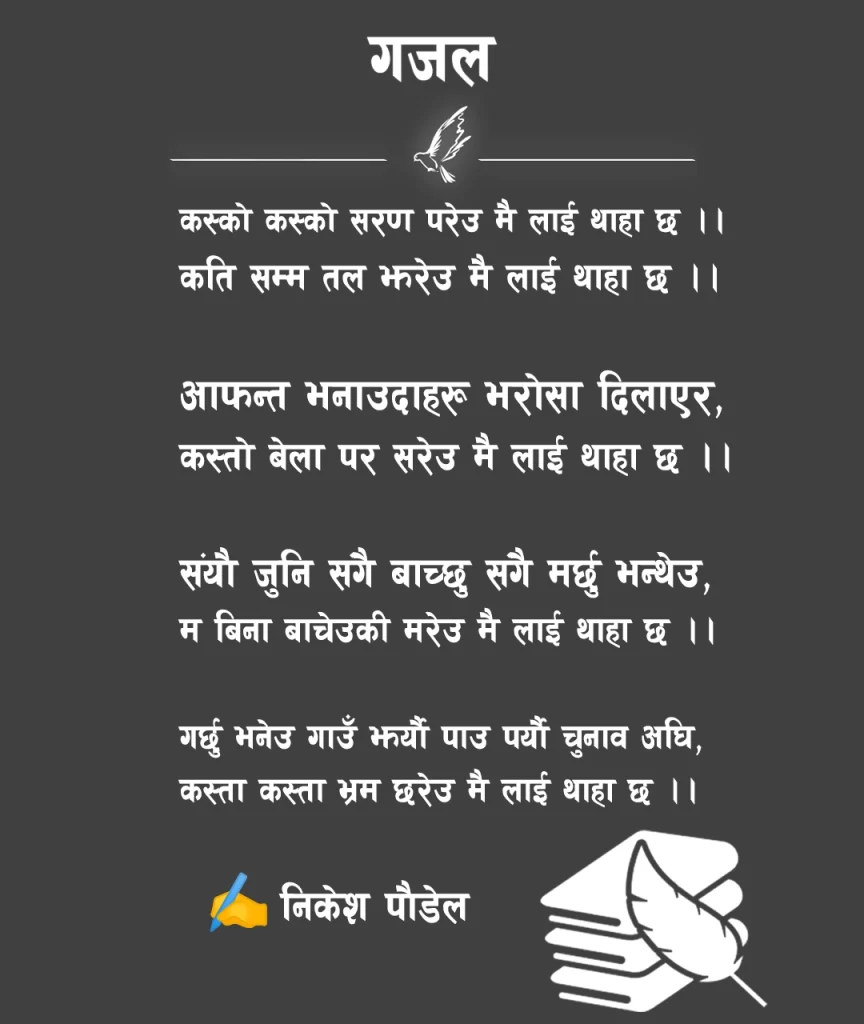
कस्को कस्को सरण परेउ मै लाई थाहा छ ।।
कति सम्म तल झरेउ मै लाई थाहा छ ।।आफन्त भनाउदाहरू भरोसा दिलाएर,
कस्तो बेला पर सरेउ मै लाई थाहा छ ।।संयौ जुनि संगै बाच्छु संगै मर्छु भन्थेउ,
म बिना बाचेउकी मरेउ मै लाई थाहा छ ।।गर्छु भनेउ गाउँ झर्यौ पाउ पर्यौ चुनाव अघि,
कस्ता कस्ता भ्रम छरेउ मै लाई थाहा छ ।।
💌 English Translation
I know whose doors you bowed at.
I know how low you were willing to fall.Those who called themselves close, promising loyalty —
I saw the moment they stepped away.You once said we would live and die together,
I know how easily you survived without me.Before elections, you touched feet and made promises —
I know the illusions you spread.
🔍 Meaning & Explanation
This Nepali Gajal reflects silent awareness. The speaker is not angry. Not shouting. Not accusing loudly. Instead, there is strength in observation.
The repeated phrase “मै लाई थाहा छ” (I know) symbolizes emotional maturity. Sometimes the most powerful response to betrayal is awareness, not revenge.
This Nepali Gajal touches three deep themes:
- Personal betrayal
- Broken promises in relationships
- Political hypocrisy and social deception
The emotional struggle here is internal. The pain comes from watching people change when power, opportunity, or fear appears.
From my experience as a literary analyst, poetry like this resonates because it mirrors real life. We have all seen:
- Friends disappearing during hard times
- Lovers changing their priorities
- Leaders promising change before elections
This Nepali Gajal doesn’t exaggerate — it simply reflects truth.
LSI Keywords Used Naturally:
- Nepali poetry
- Emotional gajal
- Betrayal poem
- Political satire poetry
- Nepali shayari
At its core, this is not just a betrayal poem — it is a statement of emotional strength.
📖 Background of the Work
This Nepali Gajal appears rooted in social observation. The political reference to election-time promises connects deeply with Nepali society. It reflects how leaders seek votes with humility but change afterward.
The relational lines suggest a universal experience — promises of forever that quietly fade.
Such themes are common in powerful Nepali poetry, where personal emotions blend with social commentary.
💡 Life Lessons from This Nepali Gajal
- Awareness is stronger than confrontation.
- Not everyone who promises loyalty will stay.
- Political words often serve temporary purposes.
- Emotional strength grows in silence.
- Truth does not need loud proof.
- Observing quietly protects your dignity.
Question for you:
Have you ever known the truth about someone but chose silence over drama?
🌸 Why This Work Inspires Readers
This Nepali Gajal inspires because it validates silent pain.
Students facing friendship betrayal.
Professionals experiencing workplace politics.
Citizens disappointed by leaders.
Lovers realizing promises fade.
It tells readers:
You are not foolish for trusting. You are strong for surviving.
Unlike dramatic revenge poetry, this piece empowers through calm clarity.
✍️ FAQ
1. What is the main theme of this Nepali Gajal?
The main theme is betrayal — in relationships and politics. It highlights awareness and emotional maturity rather than revenge.
2. Why is repetition important in this poem?
The repetition of “मै लाई थाहा छ” emphasizes silent strength and awareness. It creates rhythm while reinforcing emotional certainty.
3. Is this Nepali Gajal political?
Partially. It uses political imagery (election promises) to reflect broader social hypocrisy.
4. Who can relate to this poem?
Anyone who has faced broken trust — in friendship, love, or leadership — will connect deeply with this emotional gajal.
🔗 Related Posts (Internal Linking)
If you enjoy reading powerful Nepali Gajal and poetry, explore:
- Read more emotional pieces at: https://nikeshpaudel.com.np/nepali-gajal/
- Discover expressive verses here: https://nikeshpaudel.com.np/nepali-poem/
- Explore deep love poetry: https://nikeshpaudel.com.np/best-nepali-love-poem/
- Read about dreams vs reality: https://nikeshpaudel.com.np/nepali-gajal-dreams-vs-reality/
- Another powerful social reflection: https://nikeshpaudel.com.np/challenges-of-elderly-care-in-nepal-gajal/
👤 Author Profile
Nikesh Paudel
Writer | SEO Strategist | Literary Analyst
🌐 Website: https://www.nikeshpaudel.com.np
📧 Email: [email protected]
📘 Facebook: https://www.facebook.com/nikeshpaudel2
🎵 TikTok: https://www.tiktok.com/@nikeshpaudelofficial
📺 YouTube: https://www.youtube.com/@nikeshpaudel
🐦 Twitter: https://www.twitter.com/nikeshpaudel
📸 Instagram: https://www.instagram.com/nikeshpaudelofficial
Motivational Quote:
“Silent strength is louder than public revenge.”
💖 Call To Action
If this Nepali Gajal touched your heart, don’t keep it to yourself.
Share it with someone who needs quiet strength.
Comment your thoughts below.
Subscribe for more powerful Nepali poetry and emotional reflections.
Let’s build a community where truth is spoken calmly and felt deeply.