
Nepali Gajal That Asks the Questions We Avoid
📌 When the world keeps running,
someone has to ask why.
📑 Table of Contents
- Introduction
- Best Nepali Gajal
- English Translation
- Meaning & Explanation
- Background of the Work
- Life Lessons
- Why This Work Inspires Readers
- FAQ
- Related Posts
- Author Profile
- Call To Action
- Tags
✨ Introduction
Some poems don’t comfort you.
They wake you up.
📌 They force you to look at the systems, habits, and silence we accept without question.
This Nepali Gajal is not gentle. It is honest. It questions beauty without purpose, power without accountability, speed without sense, and justice without fairness. It speaks for those who see clearly but are punished for it.
📜 Best Nepali Gajal
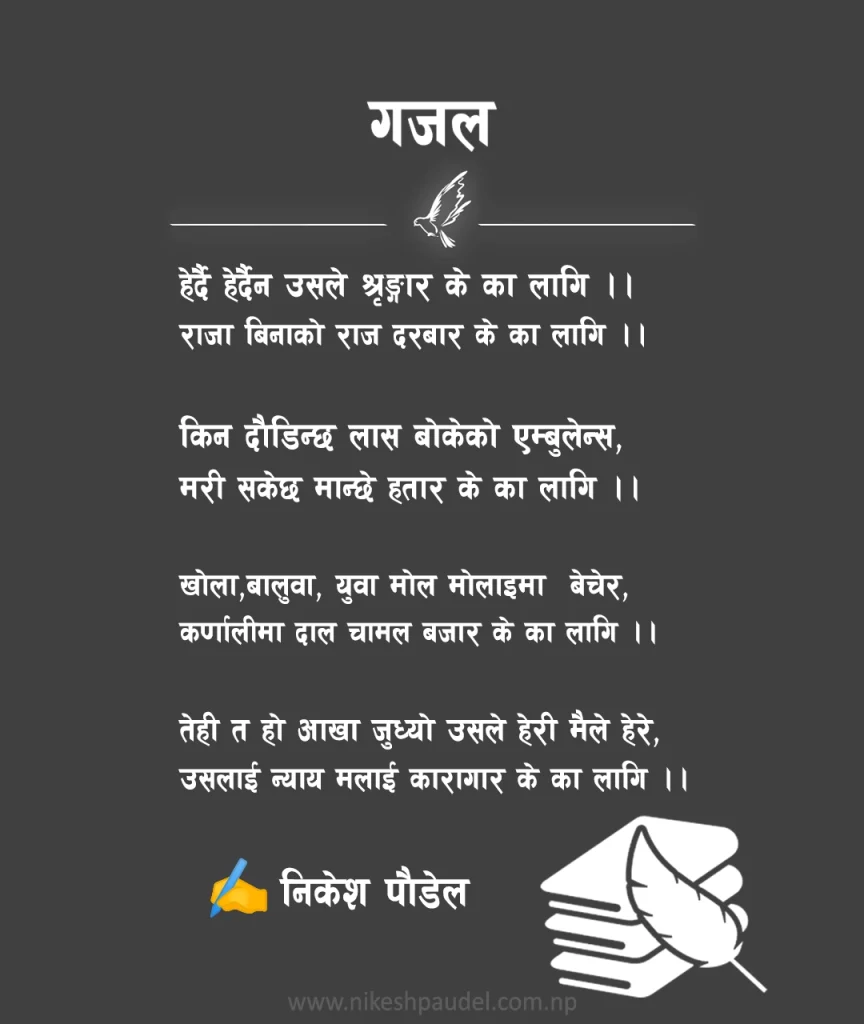
हेर्दै हेर्दैन उसले शृङ्गार के का लागि ।।
राजा बिनाको राज दरबार के का लागि ।।किन दौडिन्छ लास बोकेको एम्बुलेन्स,
मरी सकेछ मान्छे हतार के का लागि ।।खोला,बालुवा, युवा मोल मोलाइमा बेचेर,
कर्णालीमा दाल चामल बजार के का लागि ।।तेही त हो आखा जुध्यो उसले हेरी मैले हेरे,
उसलाई न्याय मलाई कारागार के का लागि ।।
💌 English Translation (Natural & Human)
Why decorate when no one truly looks,
Why keep a royal court without a king?Why does an ambulance race with a dead body,
When the person is already gone?After selling rivers, sand, and youth for profit,
Why is even food expensive in Karnali?It was just a shared glance, we looked at each other,
Why does she get justice and I get prison?
🔍 Meaning & Explanation
This Nepali Gajal is sharp social criticism wrapped in simple language.
The opening lines question meaningless appearances and hollow power. Decoration without attention and authority without leadership both symbolize empty systems that exist only to maintain illusion.
The ambulance line is devastating. It exposes how urgency often replaces logic. Systems move fast even when purpose is lost, just to appear functional.
The Karnali reference hits deep. Selling natural resources and youth labor, yet failing to provide basic food affordability, reflects economic injustice and policy failure. This is lived reality for many.
The final couplet is the most personal and painful. A simple human moment becomes criminalized. Power decides who is innocent and who is punished. As someone deeply engaged with literature and society, this is where the gajal transforms from poetry into testimony.
This Nepali Gajal does not exaggerate. That is what makes it powerful.
📖 Background of the Work
This gajal feels born from observation rather than imagination.
From watching systems fail people quietly.
It reflects social inequality, misuse of authority, and the emotional cost of speaking truth in an unfair structure. The credibility comes from how close it feels to real life.
💡 Life Lessons From This Nepali Gajal
- Appearance without purpose is meaningless
- Power without responsibility creates injustice
- Speed does not equal efficiency
- Exploiting resources weakens society long-term
- Justice often depends on who holds power
- Questioning systems is not wrong, silence is
Which line made you uncomfortable, and why?
🌸 Why This Work Inspires Readers
This gajal respects the reader’s intelligence.
It does not explain everything. It trusts you to understand.
Students questioning systems, citizens frustrated by inequality, and thinkers tired of surface-level narratives all feel seen here. It reminds readers that asking “why” is an act of courage.
That honesty is why this Nepali Gajal stays relevant.
✍️ FAQ
What is the main theme of this Nepali Gajal?
The main theme is social hypocrisy and injustice. It questions power structures, meaningless rituals, economic inequality, and selective justice.
Why is this gajal considered bold?
Because it directly challenges authority, systems, and social silence without hiding behind metaphor-heavy language.
Is this gajal political?
It is socially conscious, not party-political. It focuses on human impact rather than ideology.
Who should read this gajal?
Anyone who thinks critically about society, justice, and inequality will strongly connect with this work.
🔗 Related Posts (Internal Linking)
- Explore more thought-provoking works in this Nepali Gajal collection:
https://nikeshpaudel.com.np/nepali-gajal/ - Read socially reflective pieces from the Nepali poem archive:
https://nikeshpaudel.com.np/nepali-poem/ - A powerful gajal on social reality and sacrifice:
https://nikeshpaudel.com.np/nepali-gajal-dreams-sacrifice/ - Read about care, neglect, and dignity in society:
https://nikeshpaudel.com.np/challenges-of-elderly-care-in-nepal-gajal/
👤 Author Profile
Nikesh Paudel
Content Creator | SEO Strategist | Literary Analyst
🌐 Website: https://www.nikeshpaudel.com.np
📧 Email: [email protected]
📘 Facebook: https://www.facebook.com/nikeshpaudel2
🎵 TikTok: https://www.tiktok.com/@nikeshpaudelofficial
▶️ YouTube: https://www.youtube.com/@nikeshpaudel
🐦 Twitter: https://www.twitter.com/nikeshpaudel
📸 Instagram: https://www.instagram.com/nikeshpaudelofficial
Motivational Quote:
Questioning the system is the first step toward fixing it.
💖 Call To Action
If this Nepali Gajal made you pause, share it.
If it made you angry, talk about it.
If it felt true, don’t ignore it.
Leave a comment with the line that stayed with you.
Subscribe for writing that asks real questions.