✨Introduction: When Words Become a Wake-Up Call
There are poems that entertain, and then there are poems that break you open. This Nepali motivational gajal — anchored in the haunting refrain “अनि काम आउछ” — belongs to the second kind. It is not gentle. It does not coddle. It grabs you by the collar and tells you the raw, uncomfortable truth that most of us avoid our entire lives: talent without bold action is absolutely worthless.
Every single verse of this gajal confronts a different human habit — the habit of dreaming without doing, loving without sacrificing, guarding without investing, protecting yourself so carefully that you never actually live. If you have ever asked yourself, “Why isn’t my life moving forward?” — this poem may well be the most honest answer you will ever receive.
In Nepal’s literary tradition, the gajal is a form of lyrical poetry rooted in Persian and Urdu literary heritage, adapted beautifully into Nepali over centuries. A gajal speaks from the heart, often in paradox and metaphor, forcing the reader to sit with discomfort until understanding blossoms. This particular Nepali motivational gajal does exactly that — it uses paradox after paradox to demolish your excuses and rebuild your willpower. Whether you are a student, a professional, an entrepreneur, or simply someone who feels stuck, these eight couplets speak directly to you.
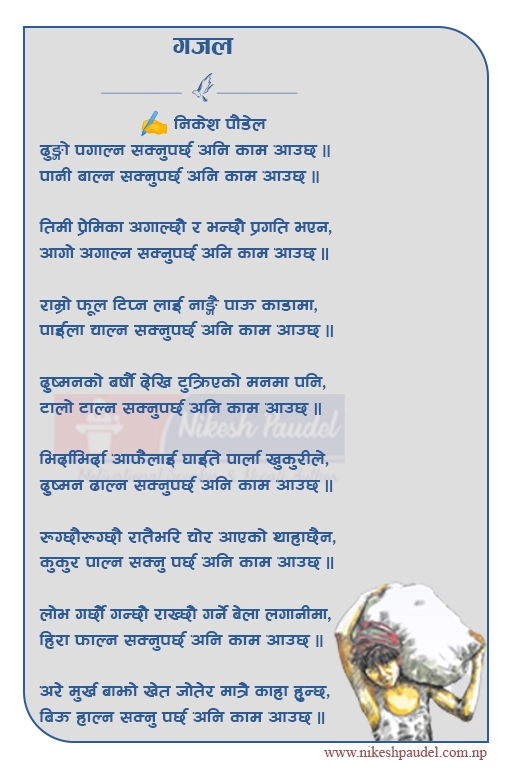
📜Original Nepali Gajal — काम आउछ
पानी बाल्न सक्नुपर्छ अनि काम आउछ ।।
आगो अगाल्न सक्नुपर्छ अनि काम आउछ ।।
पाईला चाल्न सक्नुपर्छ अनि काम आउछ ।।
टालो टाल्न सक्नुपर्छ अनि काम आउछ ।।
दुष्मन ढाल्न सक्नुपर्छ अनि काम आउछ ।।
कुकुर पाल्न सक्नु पर्छ अनि काम आउछ ।।
हिरा फाल्न सक्नुपर्छ अनि काम आउछ ।।
बिऊ हाल्न सक्नुपर्छ अनि काम आउछ ।।
💌English Translation
You must be able to melt stone — only then does it serve its purpose. / You must be able to set water on fire — only then does it come to use.
You embrace your girlfriend and wonder why progress hasn’t come — / You must be able to embrace fire itself — only then does it come to use.
To pick the most beautiful flower, you must walk barefoot through thorns — / You must be willing to take that step — only then does it come to use.
Even in the heart shattered for years by your enemy — / You must be able to stitch it back and move on — only then does it come to use.
If you keep striking recklessly, the blade will wound yourself — / You must be able to truly fell your enemy — only then does it come to use.
You keep crying through the night without even knowing a thief came — / You must be able to keep a guard dog — only then does it come to use.
You hoard, you count, you save — but at the moment of real investment — / You must be willing to throw diamonds — only then does it come to use.
Oh fool, what good is plowing a barren field over and over? / You must be able to sow the seed — only then does it come to use.
🔍Meaning & Deep Explanation
This Nepali motivational gajal is a masterclass in the philosophy of bold, decisive action. At its core, it argues something most motivational content shies away from: preparation alone is never enough. The poem doesn’t just inspire — it confronts, challenges, and almost accuses the reader of a very human crime: the crime of almost.
The opening couplet, melting stone and igniting water, are deliberately impossible images. The poet is telling you: the most important capability you need in life is the ability to do what seems impossible. It is a call for extraordinary commitment, not ordinary effort. In my own experience as someone who has navigated multiple failures before finding my footing, I can honestly say that this verse described my own paralysis more accurately than any self-help book ever did.
The second couplet is perhaps the most cutting. You embrace comfort — your beloved, your relationships, your distractions — and wonder why life isn’t progressing. The poet’s answer is unsparing: you must embrace fire. Progress is not warm and comfortable. Progress burns. This is where most people turn back, and the Nepali motivational gajal refuses to let you look away from that truth.
The flower-and-thorns verse speaks beautifully to the idea that beauty and achievement always hide behind pain. Nobody picks the rarest flower in a meadow — they pick it on the clifftop, barefoot, bleeding. The rose blooms on the cliff edge, as another poem by the same author reminds us — and the reader who cannot walk that cliff will never hold it.
The broken-heart couplet carries deep emotional intelligence. How many people carry decade-old wounds, using past trauma as a reason for present inaction? The poet validates the wound — your heart really was broken by an enemy, by loss, by betrayal — and then lovingly demands that you stitch it yourself, that you become the healer of your own story. This emotional resilience and the belief that life is never truly a loss runs throughout the author’s body of work.
The khukuri verse is a warning about uncontrolled anger and effort — striking blindly may injure yourself more than your opponent. Strategy and precision matter. And the crying-all-night verse? It is aimed squarely at those who complain about their circumstances but take no protective measures, no preparation, no systems. The dog is a metaphor for foresight, for putting structures in place before the thief arrives.
The diamond couplet may be the most powerful for entrepreneurs and investors: hoarding your resources out of fear means never multiplying them. True wealth — of money, of knowledge, of love — requires you to let go of the diamond to receive ten more in return. And the final image of the barren field is devastating in its simplicity: you can labor endlessly on an empty plot, but without planting the seed — without committing, without betting on yourself, without taking the irreversible first step — nothing can grow.
📖Background of the Work
This gajal was composed by Nikesh Paudel, a Nepali poet and author whose work consistently bridges literary tradition with contemporary motivational thought. Writing from the mountains and valleys of Nepal, Paudel draws on the lived realities of Nepali society — the young people who migrate abroad chasing dreams, the farmers who plow year after year without harvest, the lovers who mistake comfort for progress.
The gajal form itself is significant. In South Asian literary tradition, the gajal carries its meaning through a repeating refrain — here, “अनि काम आउछ” — that builds in force with each iteration. By the eighth couplet, the refrain is no longer a gentle suggestion. It is a verdict. It becomes a thunderclap. The repetition is the poetry’s greatest rhetorical weapon.
Paudel has noted that this poem grew from observations of talented people remaining stagnant — not for lack of ability, but for lack of the will to act boldly. Nepal, like many developing nations, has no shortage of intelligence or ambition. What it sometimes lacks is the cultural permission to fail loudly, to invest visibly, to walk the thorny path in public. This gajal is both a social commentary and a deeply personal challenge to every reader.
The work resonates particularly with the tradition of Nepali stories about kings, generals, and strategic courage — figures who understood that waiting for the perfect moment is itself the greatest enemy of progress.
💡Life Lessons from This Gajal
-
1Comfort is the enemy of progress. Embracing what feels safe — routine, familiar relationships, easy environments — keeps you warm but never moves you forward. This gajal teaches that real growth demands embracing the discomfort of fire, not the ease of a soft embrace.
-
2Every beautiful reward hides behind painful effort. The finest flowers grow among the sharpest thorns. Whether it’s a career milestone, a loving relationship, or personal peace — you will walk barefoot through something difficult to reach it. Accept this, and walk anyway.
-
3Healing your wounds is your responsibility, not your excuse. Past betrayal and heartbreak are real. But the poem insists you must stitch your own wounds and move forward. Staying wounded is not loyalty to your pain — it is just postponing your life. As explored in letting go after a breakup, release is power, not surrender.
-
4Reckless action is as dangerous as no action. Swinging a blade carelessly wounds you. Energy without direction is self-destruction. Courage must be paired with strategy, patience, and precision to truly fell the obstacles in your path.
-
5Hoarding your best is the slowest way to lose everything. Whether it is money, talent, love, or knowledge — the unwillingness to invest it, to throw the diamond and trust in its return, is what keeps most people permanently small. Real abundance requires release and risk.
-
6Effort without the right starting step is wasted labor. Plowing a field is hard, honest work — but without sowing the seed, it produces nothing. Many of us are extraordinarily busy doing everything except the one essential action that would actually change our lives. Find the seed. Plant it today.
🌸Why This Gajal Inspires Readers
What makes this Nepali motivational gajal so deeply affecting is that it does not speak at you — it speaks about you. Every single couplet is a mirror, and in that mirror, most of us will recognize ourselves with uncomfortable clarity.
Students see themselves in the barren field — working hard at the surface of their preparation but never committing to the actual examination of what they truly believe in and want to study. Professionals see themselves in the diamond couplet — sitting on skills, connections, and ideas they are too afraid to invest publicly. Parents see themselves in the crying-all-night verse — worrying endlessly about their children’s future while failing to put protective wisdom in place.
And lovers — those who have lost someone and carry that fracture for years — see themselves most painfully in the broken-heart verse. This poem does not tell you to stop loving what you lost. It tells you to stitch the wound and walk again. There is profound compassion hidden inside what initially sounds like severity.
The broader literary world of this author — which includes gajals on how relationships change us, poems on the irreversibility of time, and stories about what real success truly demands — creates a rich ecosystem of thought in which this gajal is perhaps the most urgent and confrontational piece.
Ultimately, this poem is about the gap between knowing and doing — a gap that swallows most human potential alive. The gajal does not close that gap for you. It simply makes you so aware of it, so uncomfortably aware, that continuing to ignore it becomes harder than crossing it.
✍️Frequently Asked Questions
💖 You Are Closer Than You Think
Every great life begins with one courageous seed planted in uncertain soil. If this gajal moved you — even slightly — that movement is your answer. Don’t let it pass. Share this poem with someone who needs to hear it. Leave a comment. Subscribe. Be part of this journey toward a life that is fully, fiercely lived.
🌱 Explore More on NikeshPaudel.com.np →