
📑 Table of Contents
- ✨ Introduction
- 📜 Best Nepali Gajal
- 💌 English Translation
- 🔍 Meaning & Explanation
- 📖 Background of the Work
- 💡 Life Lessons
- 🌸 Why This Work Inspires Readers
- ✍️ FAQ
- 🔗 Related Posts
- 👤 Author Profile
- 💖 Call To Action
✨ Introduction
Sometimes love looks like strictness.
Sometimes tears are part of growth.
This Nepali Gajal speaks about parenting, responsibility, and the uncomfortable truths of raising a child in today’s world.
We live in a generation that wants comfort instantly, success quickly, and respect automatically. But becoming a “human” — a real, responsible person — requires discipline, sacrifice, and sometimes pain.
This emotional Nepali Gajal gently reminds us: growth is never accidental.
📜 Best Nepali Gajal
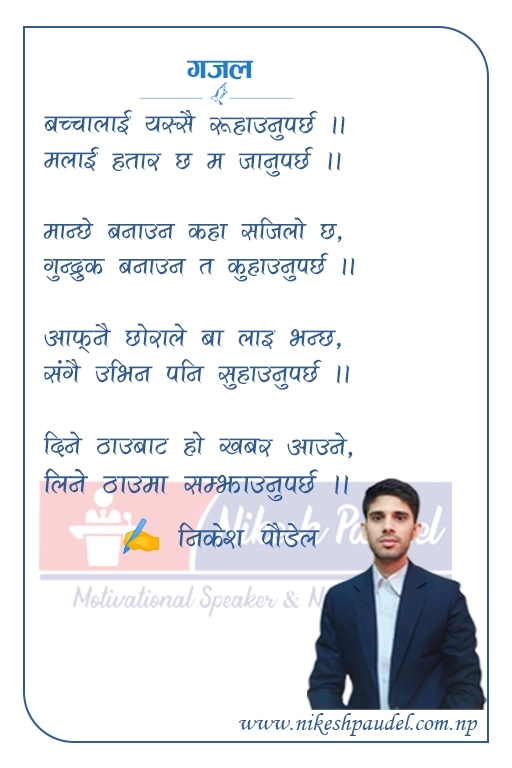
बच्चालाई यस्सै रूहाउनुपर्छ ।।
मलाई हतार छ म जानुपर्छ ।।मान्छे बनाउन कहाँ सजिलो छ,
गुन्द्रुक बनाउन त कुहाउनुपर्छ ।।आफ्नै छोराले बा लाइ भन्छ,
संगै उभिन पनि सुहाउनुपर्छ ।।दिने ठाउबाट हो खबर आउने,
लिने ठाउमा सम्झाउनुपर्छ ।।
💌 English Translation
A child must sometimes be allowed to cry —
I am in a hurry; I must go.It’s not easy to shape a human being,
Even gundruk needs time to ferment.A son now tells his own father —
Even standing beside him must look worthy.News comes from the one who gives,
But where we receive, we must be reminded.
🔍 Meaning & Explanation
This Nepali Gajal touches a sensitive nerve in modern society — parenting and generational change.
The first couplet may sound harsh: letting a child cry. But it reflects discipline. Not every tear is cruelty; sometimes it’s preparation for life’s bigger storms.
The metaphor of gundruk is brilliant. Even something as simple as fermented greens requires time, pressure, and transformation. How can raising a responsible human be easier? This emotional Nepali poetry reminds us that discomfort builds character.
The third verse speaks about shifting respect. Today, children often judge their parents by status, money, or social image. “Standing together must look suitable” — this line reflects pride, ego, and generational distance.
The final couplet criticizes social behavior. Advice often comes from those who give — but those who receive must be taught gratitude. It’s a reflection on entitlement culture.
As someone observing modern family dynamics, I’ve seen how love is misunderstood as control, and discipline mistaken for lack of affection. But true parenting is long-term vision, not short-term comfort.
This motivational Nepali Gajal blends satire, realism, and emotional depth into a powerful social message.
📖 Background of the Work
This Nepali Gajal reflects changing family values in contemporary Nepal.
Urbanization, social media influence, economic pressure, and exposure to global culture have transformed parent-child relationships. Respect is evolving. Expectations are shifting.
This heartfelt Nepali verses piece captures that tension — between traditional discipline and modern independence.
It stands as both reflection and reminder.
💡 Life Lessons
- Discipline today prevents regret tomorrow.
- Real growth requires discomfort.
- Respect for parents should not depend on status.
- Entitlement weakens character.
- Time and patience shape strong individuals.
- Love is not always soft — sometimes it is firm.
👉 Do you think strict parenting builds stronger character, or does it create emotional distance?
🌸 Why This Work Inspires Readers
Every parent struggles silently.
Every child misunderstands something at some point.
This Nepali Gajal connects both sides.
Students preparing for exams…
Young adults chasing careers…
Parents sacrificing quietly…
It validates their struggles.
This isn’t just emotional Nepali poetry — it is social truth wrapped in rhythm.
If you’ve ever felt your parents were too strict, or if you’re a parent worrying whether you’re doing enough — this piece understands you.
And sometimes understanding heals generations.
✍️ FAQ
1. What is the main message of this Nepali Gajal?
This Nepali Gajal highlights parenting struggles, discipline, generational gaps, and responsibility. It emphasizes that shaping character requires patience, effort, and sometimes discomfort.
2. Why is “gundruk” used as a metaphor?
Gundruk requires fermentation and time to become flavorful. Similarly, building strong character demands pressure, patience, and transformation.
3. Is strict parenting necessary?
Balanced discipline helps build resilience and responsibility. However, it must be combined with emotional support and communication.
4. How does this Nepali Gajal reflect modern society?
It addresses entitlement, changing respect dynamics, and shifting family values in today’s generation.
🔗 Related Posts (Internal Linking)
If this Nepali Gajal resonated with you, explore more emotional writing:
- Read more powerful Nepali Gajal collections:
https://nikeshpaudel.com.np/nepali-gajal/ - Discover deeply emotional Nepali Poem works:
https://nikeshpaudel.com.np/nepali-poem/ - Explore heartfelt romance in Best Nepali Love Poem:
https://nikeshpaudel.com.np/best-nepali-love-poem/ - Reality vs dreams in this touching gajal:
https://nikeshpaudel.com.np/nepali-gajal-dreams-vs-reality/ - A strong social reflection piece here:
https://nikeshpaudel.com.np/challenges-of-elderly-care-in-nepal-gajal/
👤 Author Profile
Nikesh Paudel
Content Creator | SEO Strategist | Literary Writer | Motivational Voice
🌐 Website: https://www.nikeshpaudel.com.np
📧 Email: [email protected]
📘 Facebook: https://www.facebook.com/nikeshpaudel2
🎵 TikTok: https://www.tiktok.com/@nikeshpaudelofficial
▶ YouTube: https://www.youtube.com/@nikeshpaudel
🐦 Twitter: https://www.twitter.com/nikeshpaudel
📸 Instagram: https://www.instagram.com/nikeshpaudelofficial
“Strong roots grow from disciplined soil.”
💖 Call To Action
If this Nepali Gajal touched your heart, share it with your parents — or your children.
Comment your thoughts.
Start a conversation at home.
Subscribe for more motivational Nepali poetry that connects generations.
Because healing begins with understanding. 💛