
📑 Table of Contents
- Introduction
- Best Nepali Gajal
- English Translation
- Meaning & Explanation
- Background of the Work
- Life Lessons
- Why This Work Inspires Readers
- FAQ
- Related Posts
- Author Profile
- Call To Action
✨ Introduction
Sometimes we blame others for storms,
But forget… we were the wind.
Life has a quiet way of teaching us that many beginnings — good or bad — are born from our own choices. This Nepali Gajal explores self-realization, ego clashes, emotional contradictions, and the strange intoxication of silent victories.
It’s not just poetry.
It’s a mirror.
📜 Best Nepali Gajal
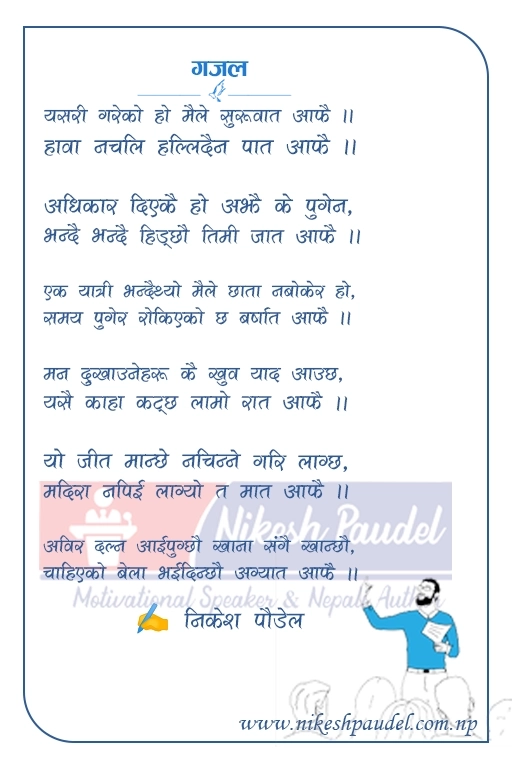
“यसरी गरेको हो मैले सुरूवात आफै ।।
हावा नचलि हल्लिदैन पात आफै ।।”अधिकार दिएकै हो अझै के पुगेन,
भन्दै भन्दै हिड्छौ तिमी जात आफै ।।एक यात्री भन्दैथ्यो मैले छाता नबोकेर हो,
समय पुगेर रोकिएको छ बर्षात आफै ।।मन दुखाउनेहरू कै खुव याद आउछ,
यसै काहा कट्छ लामो रात आफै ।।यो जीत मान्छे नचिन्ने गरि लाग्छ,
मदिरा नपिई लाग्यो त मात आफै ।।अविर दल्न आईपुग्छौ खाना संगै खान्छौ,
चाहिएको बेला भईदिन्छौ अग्यात आफै ।।
💌 English Translation
“It was I who began it this way,
Leaves don’t move unless the wind blows.”I gave you rights — what more was lacking?
Yet you walk away, claiming your own identity.A traveler once said, “I didn’t carry an umbrella,”
And the rain stopped on its own when the time came.Strangely, I remember most those who hurt me —
How does such a long night pass by itself?This victory feels unfamiliar,
I’m intoxicated without drinking.You arrive to celebrate and share meals,
Yet when needed most, you disappear unknown.
🔍 Meaning & Explanation
This Nepali Gajal dives deep into human psychology — responsibility, ego, memory, pride, loneliness, and social hypocrisy.
The opening couplet is powerful.
The poet admits: “I started this myself.”
It reflects maturity — recognizing that conflicts rarely happen without cause. Like wind moving leaves, actions trigger reactions.
In emotional Nepali poetry, self-accountability is rare but impactful. This sets a reflective tone for the entire Nepali Gajal.
The second stanza hints at ego and entitlement. Even after giving space and respect, dissatisfaction remains. This mirrors modern relationships — whether romantic, friendship, or professional.
The traveler metaphor about rain suggests destiny. Sometimes we prepare for storms unnecessarily. When time changes, even heavy rain stops on its own. A motivational gajal element quietly reminds us: patience often solves what panic cannot.
The most emotionally resonant line speaks about remembering those who hurt us. Human memory clings to pain stronger than joy. Long nights symbolize overthinking — something many readers silently battle.
Then comes a unique twist: victory without recognition. Success feels lonely. There’s intoxication — not from alcohol — but from achievement that others fail to acknowledge. This is a strong theme in contemporary Nepali literature where individuals struggle quietly before rising.
Finally, the last couplet exposes social behavior:
People celebrate success but vanish in struggle.
As someone who has experienced support disappearing during hard phases, I personally feel this truth deeply. This Nepali Gajal is not just about emotion — it is about awareness.
It teaches:
- Own your beginnings.
- Accept your reactions.
- Observe people’s presence and absence.
- Recognize that loneliness sometimes accompanies growth.
📖 Background of the Work
This heartfelt Nepali verse reflects modern societal behavior — especially among youth navigating friendships, love, ambition, and social validation.
In today’s digital age, people show up for celebrations (success posts, achievements) but rarely for silent breakdowns. That contrast shapes the emotional depth of this Nepali Gajal.
The poem stands as both emotional confession and social commentary.
💡 Life Lessons
Here’s what we can learn:
- 🌬️ Every conflict has a starting wind — reflect before blaming.
- 🎭 Not everyone who celebrates you truly supports you.
- 🌧️ Storms don’t last forever — timing changes everything.
- 🌙 Nights feel longer when thoughts are louder.
- 🏆 Success may feel lonely — stay humble and grounded.
- 👁️ Observe actions more than words.
👉 Which couplet felt most personal to your current life situation?
🌸 Why This Work Inspires Readers
This Nepali Gajal resonates with:
- Students facing silent competition
- Professionals dealing with workplace ego
- Friends drifting apart
- Individuals rising without recognition
It speaks to those who feel unseen, unheard, yet evolving.
If you appreciate reflective emotional Nepali poetry like this, you may also enjoy exploring deeper collections of Nepali Gajal and related works that blend reality with raw emotion.
Because sometimes, growth feels like isolation — but it is actually transformation.
✍️ FAQ
1. What is the main theme of this Nepali Gajal?
The central theme is self-realization and emotional awareness. It highlights responsibility in conflicts, loneliness in success, and the temporary nature of struggles.
2. Why does the poem mention rain stopping on its own?
It symbolizes time and destiny. Problems often resolve naturally when the right moment arrives, teaching patience instead of panic.
3. Why do we remember those who hurt us more?
Human psychology attaches stronger emotional memory to pain. This line reflects universal truth, making the gajal deeply relatable.
4. Is this a motivational or emotional gajal?
It is both. While emotionally reflective, it subtly motivates readers toward self-awareness, maturity, and resilience.
🔗 Related Posts (Internal Linking)
If this Nepali Gajal touched your heart, explore more:
- Read more powerful pieces here:
https://nikeshpaudel.com.np/nepali-gajal/ - Dive into meaningful Nepali poems:
https://nikeshpaudel.com.np/nepali-poem/ - Explore Dreams vs Reality themed gajal:
https://nikeshpaudel.com.np/nepali-gajal-dreams-vs-reality/ - Reflect on Dreams and Sacrifice:
https://nikeshpaudel.com.np/nepali-gajal-dreams-sacrifice/ - Read about Elderly Care emotional gajal:
https://nikeshpaudel.com.np/challenges-of-elderly-care-in-nepal-gajal/
👤 Author Profile
Nikesh Paudel
Content Creator | SEO Strategist | Literary Analyst
🌐 Website : https://www.nikeshpaudel.com.np
📧 Email : [email protected]
📘 Facebook : https://www.facebook.com/nikeshpaudel2
🎵 TikTok : https://www.tiktok.com/@nikeshpaudelofficial
▶️ YouTube : https://www.youtube.com/@nikeshpaudel
🐦 Twitter : https://www.twitter.com/nikeshpaudel
📸 Instagram : https://www.instagram.com/nikeshpaudelofficial
“Self-awareness is the beginning of silent strength.”
💖 Call To Action
If this Nepali Gajal resonated with you:
💬 Share your favorite stanza in the comments.
📲 Send it to someone who needs reflection.
🔔 Follow for more emotional and motivational Nepali literature.
Let’s grow through awareness.
Let’s rise without losing ourselves.